Pinned to Death: How the Algorithm Killed the Art of Getting Lost
There's a hollow in eastern Tennessee that a retired cartographer named Gerald Pruitt has been visiting since 1974. He found it by accident — wrong turn off a fire road, a creek he decided to follow on a gut feeling, two hours of walking before the ridgeline opened up into something that felt, he says, like a held breath. He went back every few years for decades. Told almost nobody.
Last summer, he drove out there and found a couple from Nashville photographing themselves in front of the exact rock formation he'd kept to himself for fifty years. They'd found it on an app. It had 340 saves.
"I wasn't angry at them," Pruitt told us over the phone. "They were perfectly nice. But something was gone. I can't explain it exactly. The place was the same. It just wasn't a secret anymore, and secrets are half of what make a place worth finding."
This is the valley paradox in its plainest form: the better we get at locating hidden places, the less hidden — and maybe the less worth finding — they become.
The Promise That Came With the Pin
It's worth being fair about what GPS and mapping apps actually delivered. Before smartphones, remote valleys in the American West, the Southern Appalachians, or the canyon country of the Colorado Plateau were accessible mostly to people with serious resources: topographic maps, time, experience reading terrain, and often a local contact willing to share what they knew. Discovery was gatekept, and not always in ways that were equitable or particularly romantic.
Apps like AllTrails, Gaia GPS, and even Google's satellite view genuinely democratized access. A first-generation hiker from a city who never had a parent teach them to read a USGS quad sheet can now navigate backcountry with real confidence. That matters. Outdoor recreation has historically skewed white and wealthy, and lower barriers to entry have brought more people — more kinds of people — into landscapes that belong to everyone.
But democratization and commodification tend to travel together, and in the case of hidden valleys, they've become almost inseparable.
What the Data Does to a Place
Julia Morrow studies landscape perception at a small research center in Missoula, Montana. Her work focuses on how the framing of a place — the language used to describe it, the images associated with it, the reviews attached to it — changes the way visitors actually experience it.
"When you arrive somewhere with a four-star rating and 600 photos already loaded in your head, you're not discovering anything," she says. "You're confirming. You're checking boxes. The cognitive experience is completely different from arriving somewhere with no prior image."
The brain, she explains, processes genuine novelty differently than it processes recognition. The sense of wonder people associate with finding something unexpected — the elevated mood, the sharpened attention, the feeling of being fully present — is neurologically tied to actual surprise. GPS routing doesn't just tell you where to go. It tells you what to expect. And expectation, it turns out, is the enemy of awe.
This might explain something a lot of veteran valley-seekers describe but struggle to articulate: the feeling that even when a place is beautiful, it somehow doesn't land the same way when you were guided there by an algorithm.
The Residents Who Watch It Happen
For people who actually live near these places, the shift has been concrete and often unwelcome.
In a small community tucked into a valley in western North Carolina — one that asked us not to name it specifically — longtime residents describe a transformation that started gradually around 2016 and accelerated sharply after 2020, when pandemic-era remote work sent urban transplants scrambling for anywhere that wasn't a city.
"We had maybe a hundred visitors a summer for years," says one woman who's lived there her whole life. "Then somebody posted a reel and we had that many in a weekend. The creek got trashed. People were parking on private land. Someone's goats got out because hikers left a gate open."
She's not opposed to visitors in principle. She's opposed to volume that a place — ecologically and socially — wasn't built to absorb. And that volume, she says, is now algorithmically inevitable the moment a location gets tagged.
Cartographers and land managers describe a similar dynamic from a different angle. Once a coordinate exists in a database, it propagates. It gets scraped, shared, embedded in listicles, and eventually optimized into search results. A place that took a lifetime to find in 1985 can trend on a Tuesday in 2025.
Old Tools, Different Thinking
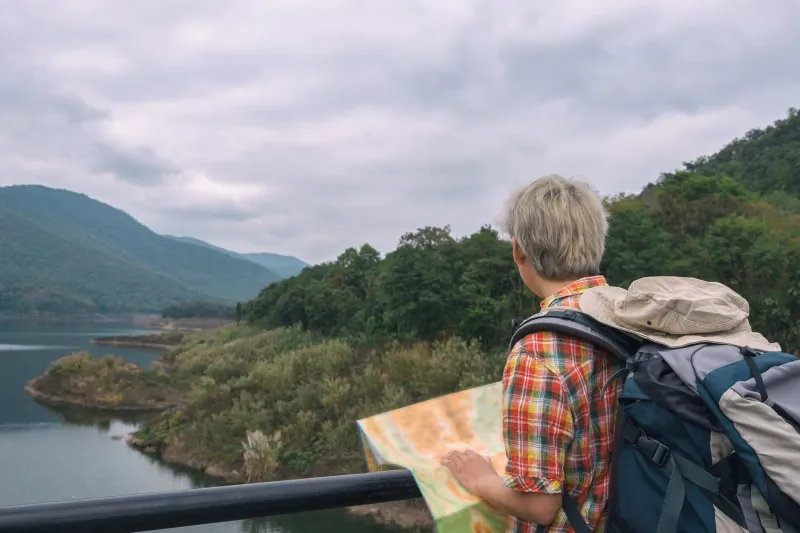
Pruitt, the cartographer, still uses paper maps for anything he actually cares about finding. Not out of nostalgia, he insists — he uses GPS for plenty of things — but because the process of reading a topo map forces a different relationship with the landscape.
"You have to think in three dimensions. You have to imagine the terrain before you're in it. You develop a feel for where water goes, where ridges break, where a valley might be hiding," he says. "That process of imagination is what makes arrival meaningful. The phone skips all of it."
This isn't a fringe view. A growing number of outdoor educators and wilderness guides are actively teaching analog navigation not just as a survival skill but as a philosophical practice — a way of restoring the cognitive engagement that GPS quietly removed.
Some backcountry outfitters have started offering what they call "nav-dark" trips: no phones, no GPS units, paper maps and compasses only. Demand, they say, is rising.
No Easy Answer Out Here
There's no clean resolution to this tension, and anyone who tells you otherwise is selling something. Restricting access to public land raises real equity concerns. Letting algorithms drive discovery at scale has real environmental and cultural costs. These are not problems that resolve neatly.
What does seem clear is that the way we use technology shapes the quality of the experience we're able to have — and that choosing to engage with a landscape on its own terms, rather than on the app's terms, is still a choice available to anyone willing to make it.
Some of the best valleys in this country aren't secret because nobody's been there. They're secret because the people who found them decided not to pin them.
Pruitt has another hollow he's been sitting on for thirty years. He's not telling us where it is. Honestly? We respect that completely.