Listen to the Land: The Hidden Soundscapes of America's Most Isolated Valleys
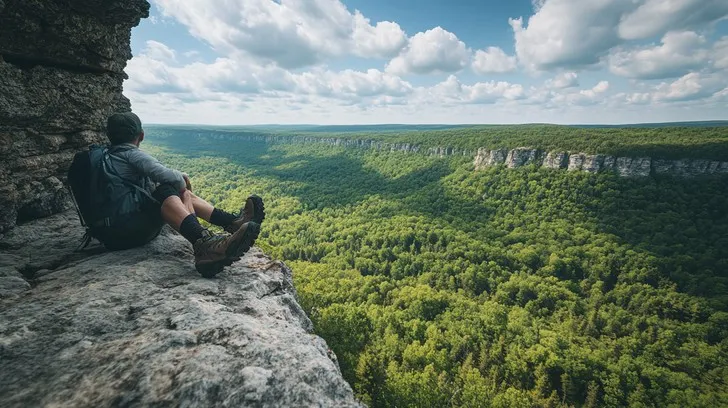
Photo: hiker sitting quietly in canyon valley listening to nature soundscape USA, via images.stockcake.com
Close your eyes somewhere deep in Zion Canyon on a Tuesday morning in March, before the crowds arrive. What you hear first is the river — the Virgin, low and cold, moving over smooth stone with a sound that isn't quite white noise and isn't quite music. Then the canyon wrens start up, their cascading calls bouncing off 2,000-foot sandstone walls in a way that makes the sound feel three-dimensional, almost architectural. Then: nothing. A silence so complete it has a texture.
You don't forget that. You might forget the color of the rock. You will not forget the sound.
Sound as Landscape
We spend a lot of energy in travel writing describing what remote places look like. The light on the cliffs at golden hour. The color of a high alpine lake. The silhouette of a ridgeline at dusk. We are, as a species, deeply visual creatures, and our travel vocabulary reflects that.
But ask experienced backcountry travelers what they remember most vividly about their time in isolated valleys and canyons, and a surprising number of them reach first for sound. The way a thunderstorm moves through a narrow canyon — the rumble arriving from one direction, then wrapping around, then seeming to come from everywhere at once. The particular hush of a snowfall in an Appalachian hollow. The way a single waterfall can fill an entire mountain basin with sound.
This is not coincidence. It's physics, geography, and biology working together to create something genuinely rare: acoustic environments that most of us have never experienced and don't have good language for.
The Science Behind the Echo
Canyons are, in acoustic terms, extraordinary structures. Their hard, parallel walls reflect sound with minimal absorption, creating echo chambers that can carry a whisper for hundreds of feet or transform a single clap into a long, rolling decay. The effect varies dramatically depending on canyon geometry — width, wall height, the presence of alcoves or overhangs — which is why no two canyons sound alike.
Slot canyons, like those found in the Navajo sandstone country of southern Utah and northern Arizona, produce some of the most distinctive acoustics on the continent. Their narrow, sinuous passages create what acoustic researchers sometimes call "flutter echo" — a rapid, stuttering repetition that can make a voice sound like it's being processed through a reverb pedal. Stand in Antelope Canyon and speak at a normal volume. The sound doesn't just bounce back; it blooms.
Mountain valleys work differently. Rather than reflecting sound between walls, they tend to funnel and channel it, creating what feels like a kind of acoustic intimacy. Sounds carry farther than you expect them to. A conversation across a valley meadow can be surprisingly audible. In the Great Smoky Mountains, hikers regularly report hearing other parties on adjacent ridges long before they're visible — the terrain acting as an unintentional amplifier.
Waterfalls complicate everything. A significant waterfall introduces broadband noise — sound across a wide range of frequencies — that can effectively mask all other acoustic detail within its radius. Step outside that radius, though, and something interesting happens: the waterfall becomes a kind of acoustic anchor, a reference point that the surrounding landscape sounds against. Birdsong near a waterfall often shifts in pitch and volume, with species that rely on acoustic communication adapting their calls to cut through the ambient roar.
The Rarest Sound in America
There is a measurement that acoustic scientists use called "natural quiet" — an environment where human-generated noise is essentially absent. True natural quiet is, in the continental United States, extraordinarily rare. The National Park Service has been monitoring it for years, and the findings are sobering: even in our most remote protected landscapes, the intrusion of aircraft noise, distant highway traffic, or industrial activity is nearly constant.
The places where genuine natural quiet still exists tend to be the deep valleys, the slot canyons, the high basins surrounded by ridges that block line-of-sight to roads and flight paths. The Boundary Waters Canoe Area in Minnesota. Certain drainages in the Frank Church–River of No Return Wilderness in Idaho. The deeper hollows of the West Virginia highlands.
If you've ever stood in one of these places and truly registered the absence of human noise, you know it's not just a neutral state. It's an active experience. The silence presses against you gently. Your own heartbeat becomes audible. The small sounds that ambient noise normally buries — a beetle in the leaf litter, the creak of a tree in light wind — surface into clarity. It's disorienting, briefly, and then it's something close to relief.
Planning Your Ears
If you want to experience the acoustic character of a hidden valley rather than just its visual drama, a few practical considerations go a long way.
Timing matters enormously. Dawn and dusk are the most acoustically rich periods in most natural landscapes — bird activity peaks, wind typically drops, and the temperature inversions that sometimes occur around sunrise can actually bend sound in ways that make distant sources seem closer. The midday hours, especially in summer, tend to be acoustically flatter.
Crowds change everything. A canyon that produces extraordinary natural acoustics on a Monday morning in November becomes an echo chamber for human chatter on a July Saturday. If acoustic experience is part of what you're after, shoulder season and early starts are worth the inconvenience.
Slow down. This is the piece of advice that sounds obvious and proves hardest to follow. The acoustic landscape of a place reveals itself over time. Sit for twenty minutes at the edge of a valley meadow and you'll hear things that a hiker passing through at trail pace will never register. The soundscape is not static — it has rhythm, texture, and surprise. You have to wait for it.
Leave the earbuds at camp. This one is non-negotiable. The practice of hiking to a remote waterfall while listening to a podcast is, acoustically speaking, the equivalent of visiting the Grand Canyon in a blindfold. The sound is the point.
What the Valley Is Saying
There's an older tradition, common to many Indigenous cultures across the American West and Appalachia, of treating the acoustic character of a landscape as meaningful — as something that carries information, history, and presence. The sound of a particular canyon or hollow was understood to be part of what that place was, not just a byproduct of its geography.
Modern acoustic ecology is arriving, through a very different route, at something similar. The soundscape of a healthy valley ecosystem is measurably different from a degraded one. More species, more acoustic diversity, more complexity in the layering of calls and responses. Sound, in this framework, becomes a kind of vital sign.
For the traveler willing to listen, that means every remote valley has something specific to say — about its health, its history, and its particular character. You just have to be quiet enough to hear it.