Stuck on Purpose: The Travelers Who Came for a Weekend and Never Went Home
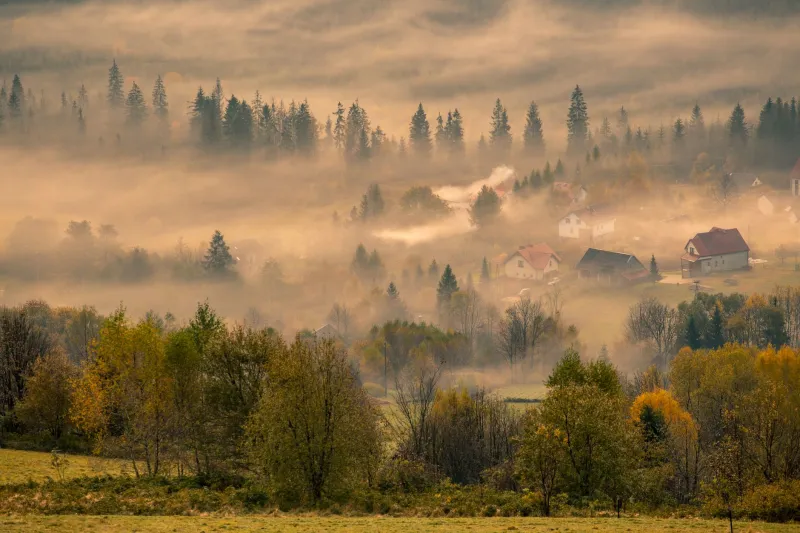
Dana Whitmore drove into the Hocking Hills region of southeastern Ohio on a Thursday in late October, planning to spend the weekend photographing fall foliage and be back at her Cincinnati desk by Monday morning. That was four years ago. Her desk has since been sold. Her apartment lease lapsed. She now lives in a converted barn with two dogs, a wood stove, and a view of a gorge that she describes, without any apparent embarrassment, as the reason she's still alive.
"I don't mean that dramatically," she says, laughing. "I just mean — I was really tired. And this place caught me."
Dana's story isn't unusual. Not in the circles where people talk honestly about why they ended up where they ended up. Across the country, in hollows and canyons, river valleys and mountain basins, there are people who arrived as visitors and quietly became residents — not through any grand decision, but through a slow accumulation of mornings that felt too good to abandon.
This is what some call the valley trap. Others resist that word entirely.
The Pull Nobody Can Quite Explain
Ask someone who stayed why they stayed, and you'll almost always get a pause before the answer. It's not that they don't know — it's that the knowing lives somewhere below language.
Marcus Tran spent a decade working in logistics in the Dallas-Fort Worth metro before a hiking trip through the Ouachita Mountains in western Arkansas turned into something he hadn't anticipated. He'd rented a cabin near the Cossatot River for ten days. By day four, he'd stopped checking his work email. By day seven, he'd called his landlord back in Texas. By day ten, he was asking locals about land prices.
"There's something about the scale of it," he says. "In the city, everything is human-sized — buildings, noise, schedules. Out here, the landscape is so much bigger than you are. And weirdly, that's a relief. You stop feeling like the main character."
That shift — from protagonist to participant — comes up again and again in conversations with long-term valley settlers. Psychologists who study place attachment describe it as a recalibration of ego and environment. When the landscape is genuinely vast, genuinely quiet, and genuinely indifferent to your presence, something in the nervous system appears to exhale.
It's not escapism, exactly. Or at least it doesn't feel that way to the people living it.
The Moment of No Return
Most people who stayed can identify a specific moment — not when they decided to stay, but when they realized they already had.
For Renee Calloway, who now runs a small herb farm in a rural valley outside Asheville, North Carolina, it was a Tuesday morning in February, three weeks into what was supposed to be a one-month retreat after her divorce. She was standing at the edge of a frost-covered field, watching mist move through the tree line, and she thought: I don't want to go anywhere else to feel better. I'm already better.
"It sounds like a cliché," she admits. "But clichés exist because something real is underneath them."
For others, the moment is less serene. James Okafor, a former software engineer from Atlanta, says his moment came during a flash flood warning in the narrow valley near Elkins, West Virginia, where he'd been staying for six weeks. Roads were washed out. Cell service was gone. He was stuck — genuinely, logistically stuck — and found himself thinking, with startling clarity, that he hoped the roads stayed closed a little longer.
"That's when I knew," he says. "You don't hope for more time in a place you're just visiting."
Escape, or Something Else?
It's easy — and maybe a little lazy — to frame these stories as escape narratives. Person burns out. Person flees city. Person finds peace in the woods. The end.
But spend enough time talking to people who've made this choice, and a more complicated picture emerges. Many of them weren't running from something as much as they were running toward a version of themselves that the pace of their previous lives hadn't left room for.
Dana puts it plainly: "I wasn't escaping my life. I was finally living one."
There's also the question of belonging — a word that shows up constantly in these conversations. Remote valleys, for all their geographic isolation, often have something that sprawling metros lack: a legible community, a shared relationship with the land, a sense that the place itself has a personality that you can either attune to or not.
Renee talks about learning the rhythms of her valley — when the creek runs high, which slopes get afternoon sun, which neighbors know how to help when something breaks — as a kind of second language. "You don't learn it overnight," she says. "But once you start to get it, leaving feels like giving up fluency."
What the Valley Asks of You
Staying isn't always romantic. Everyone who's done it will tell you that. Winters in isolated hollows are long. Services are scarce. The nearest urgent care might be forty-five minutes away on a good road day. Internet is often unreliable. Social life requires actual effort — you have to drive to it, plan for it, show up for it.
And yet, the people who stay tend to describe these inconveniences not as problems but as features. The friction, they say, is part of what makes the place real.
"The city made everything frictionless," Marcus says. "Food appeared. Entertainment appeared. Connection appeared. And somehow I felt nothing. Here, everything takes a little work, and everything feels like something."
There's a version of this that sounds like self-imposed hardship for its own sake. But there's another version — maybe the more honest one — that sounds like a return to a kind of engagement with daily life that modern convenience has quietly eroded.
The Valley Finds You
Nobody who stayed planned to stay. That's the thread that runs through every one of these stories. The decision, if you can call it that, was never made at a desk or on a map. It was made in a moment of unexpected stillness — a particular light through a particular tree line, a sound the creek made at a particular hour, a morning cold enough to make the breath visible and beautiful.
The valley didn't advertise itself. It didn't have to.
That's the thing about truly hidden places — the ones that don't make it onto the listicles or into the algorithm. They don't pull you in with spectacle. They pull you in with something quieter, something that takes a few days to even notice. And by the time you do notice, you're already asking yourself the question that changes everything:
What, exactly, am I going back to?
For some people, the answer is clear, and they leave. For others, the silence where that answer should be turns out to be the most honest thing a landscape has ever told them.
Dana still has the return ticket stub from that October weekend in Hocking Hills. She keeps it on her windowsill, not as a reminder of what she left behind, but as a small, paper proof that some journeys end somewhere the map never intended.