Closer Together at the Edge of Nowhere: How Isolation Rewires the Way We Connect

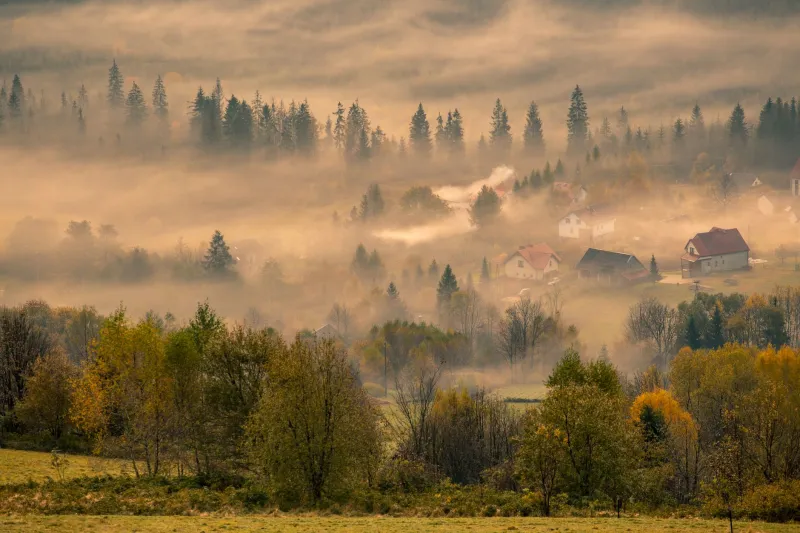
Photo by Photo by Mario Scheibl on Unsplash on Unsplash
There's a small community tucked into a valley in the Ozarks — no stoplight, one general store, a post office that doubles as a rumor mill — where a woman named Darlene has lived her entire 61 years. Ask her about loneliness and she'll laugh, not unkindly, but the way you laugh at a question that misses the point entirely.
"Lonely? Honey, I know every person within twelve miles by their truck engine," she said. "You want to feel invisible, go move to a city."
This is the valley paradox, and it keeps surprising the people who study it.
The Assumption Nobody Questions
When most Americans picture remote living — a hollow in Appalachia, a high-desert canyon community in New Mexico, a river valley in rural Montana — they picture solitude shading into isolation, and isolation shading into loneliness. It's practically cultural shorthand. We associate density with connection and emptiness with estrangement.
But a growing body of research, paired with the lived testimony of people who actually inhabit these places, is quietly dismantling that assumption. Dr. Renata Osei, a social psychologist at the University of Vermont who studies community cohesion in low-density environments, puts it plainly: "Geographic isolation doesn't reduce social connection. In many cases, it intensifies it — and it changes the quality of it in ways that are pretty remarkable."
What Osei and her colleagues have found is that when people live in places where the social pool is small and the environment is demanding, relationships stop being optional accessories to daily life. They become infrastructure.
When Community Is Load-Bearing
In dense urban environments, most Americans operate with a wide but shallow social network. You have work acquaintances, gym friends, neighbors you wave to, a core group of close friends you actually call. These networks are efficient but often compartmentalized — people who fill specific roles and rarely overlap.
Valley communities tend to collapse those compartments entirely.
"Out here, your neighbor might be the person who helps you pull a calf at 2 a.m., and also the person who brings you food when your mom dies, and also the person you argue with at the town meeting about the road budget," said Marcus, a rancher in a narrow Wyoming valley accessible by a single two-lane road. "You can't curate your relationships the way you can in a city. You just have to learn how to be in them."
That enforced depth, researchers say, produces something that's increasingly rare in American life: genuine relational fluency. People in these communities tend to be better at conflict, better at asking for help, and better at tolerating the messiness that comes with actually knowing someone.
Osei describes it as "low-exit relationships" — connections where leaving isn't easy, so people learn to work through things instead. "It's not always comfortable," she said, "but it builds a kind of social muscle that a lot of people in more transient environments never develop."
What Visitors Bring Home
Here's where it gets interesting for the rest of us — the ones who don't live in valleys but pass through them.
Travel therapists and wilderness retreat facilitators have been documenting something consistent among people who spend extended time in remote valley environments: they come back different. Not just rested. Different, in the way they communicate.
Jamila Reyes runs a wilderness immersion program in the mountains of western North Carolina, bringing small groups into isolated coves for five-to-ten-day stays with limited technology access. She's been doing it for eight years. "People arrive performing," she said. "They're used to managing how they come across. By day three in the valley, that starts to fall away. There's nothing to perform for. And once it drops, real conversation starts happening."
Participants in her programs — who range from burned-out tech workers to couples in relationship trouble to people simply chasing something they can't name — consistently report that the relationships they form during those valley stays feel more substantial than friendships they've maintained for years back home.
Part of that is the shared experience of a demanding landscape. Part of it is the absence of distraction. But Reyes believes a bigger piece is simply time — unscheduled, unoptimized time in which people have no choice but to actually be present with each other.
"We've engineered presence out of our daily lives," she said. "The valley engineers it back in."
The Reset Button Theory
Dr. Osei is careful not to romanticize what she calls the "valley reset" — the idea that a stint in a remote landscape can permanently rewire someone's relational habits. "The research suggests it can create a window," she said. "Whether people climb through it when they get home depends on what they do with the experience."
Still, the testimonials from people who've made the climb are hard to dismiss.
Trevor, a software engineer from Austin who spent three weeks last fall helping rebuild trail infrastructure in a remote Smoky Mountain hollow, said the experience exposed something he'd been ignoring for years. "I realized I'd been substituting availability for intimacy," he said. "Like, I was always technically reachable, but I was never actually there with anyone. In the valley, you're there. You can't not be."
He came home and ended two friendships he described as "performance relationships" — connections built on mutual image-management rather than genuine affection. He also, he said, finally had the hard conversation with his brother they'd been circling for a decade.
"I don't know if I would have done either of those things without the valley," he said. "It recalibrated something."
What the Valley Knows That We've Forgotten
There's an old idea — predating psychology, predating social science — that difficulty shared becomes the foundation of real community. That the people who haul wood together in November, who know which neighbor's truck won't start in a cold snap, who show up at each other's doors without being asked, are practicing something that comfortable modern life has made optional.
The valleys are still practicing it. And increasingly, people are making the trip out to those far edges not just to see beautiful country, but to remember how it feels to be genuinely known by someone.
Darlene, back in the Ozarks, doesn't have a theory about any of this. She just knows what she knows.
"People come out here thinking they're going to find quiet," she said. "And they do. But then they find us. And I think sometimes that's the part they needed more."
Maybe that's the real thing waiting at the end of the map — not emptiness, but a different, older kind of full.