Something Shifts Down Here: What Extended Time in Enclosed Landscapes Does to Your Brain

Photo by Photo by Intricate Explorer on Unsplash on Unsplash
There's a moment that a lot of valley travelers describe. It usually happens somewhere around day four or five. The noise in your head — the ambient hum of deadlines, notifications, social obligations — starts to thin out. Not because you've forced it to. Just because something in the landscape has quietly rearranged your attention.
People call it different things. Some say they feel smaller, which sounds like an insult but isn't. Others say they feel clearer, like a lens that's been wiped clean. A few just shrug and say, "I don't know, something shifted."
What's actually happening? And more importantly — is the valley doing it to you, or was it always waiting to happen?
The Neuroscience of Enclosed Spaces
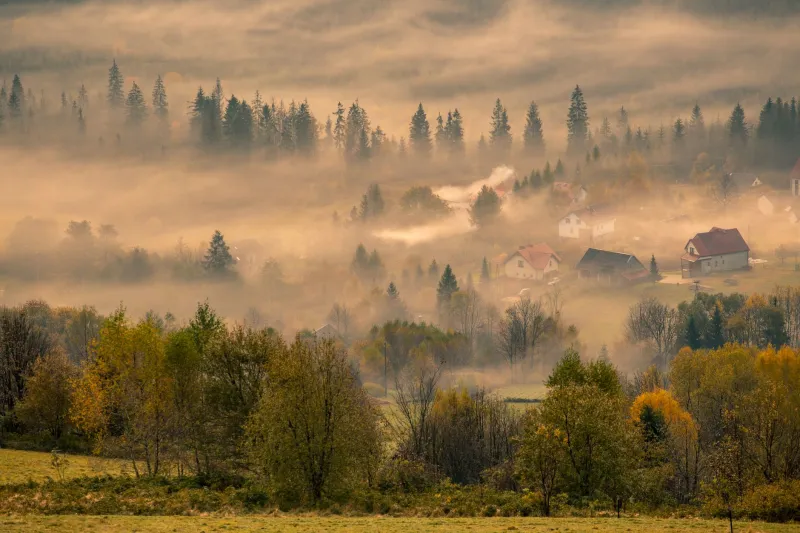
Dr. Rachel Hopson, a cognitive neuroscientist at the University of Oregon who studies environmental influences on attention and decision-making, has spent years looking at what happens to the brain when people move through landscapes that constrain and direct the visual field. Valleys — with their narrowed sightlines, layered ridgelines, and enclosed sense of scale — are particularly interesting to her.
"We're wired for horizon-scanning," she explains. "Urban environments give us fractured, high-speed visual input. Open plains give us long-range focus. But an enclosed valley does something different — it creates a kind of bounded infinity. You can see far within it, but the walls of the landscape tell your nervous system that the world has edges. And that changes how you process everything else."
Her research suggests that prolonged exposure to this kind of bounded terrain activates the parasympathetic nervous system more consistently than open or urban landscapes. In plain terms: your body stops bracing for threats it was never actually facing. The background anxiety that most of us carry around like a second phone in our pocket starts to discharge.
What follows, she says, is often a period of cognitive reorganization. "When the noise clears, people start to re-evaluate what they were actually optimizing for. It's not that the valley gives them new values. It's that it removes enough interference for their actual values to surface."
What Long-Term Residents Notice About Visitors
Ask anyone who's lived in a remote valley for a decade or more and they'll tell you they've watched this process play out hundreds of times. They have a name for it in some communities — "the drop," referring to the moment when a visitor stops performing their outside-world identity and starts just existing.
Martha Kinsley has run a small guesthouse in a hollow in the Allegheny Mountains of West Virginia for going on eighteen years. She's watched lawyers, tech workers, teachers, and retirees all move through some version of the same arc. "The first two days, they're still somewhere else in their heads," she says. "They're checking their phones even when there's no signal, just out of habit. By day five or six, they've stopped doing that. By day ten, they start asking me questions I don't usually get — about the land, about what grows where, about how I decided to stay."
That last part is significant. The questions change. Visitors who arrived asking about hiking distances and waterfall coordinates start asking about something harder to quantify: how people make choices about their lives.
"I think they're really asking about themselves," Kinsley says. "But they're not ready to ask it directly yet."
The Technology Withdrawal Nobody Talks About
One of the more consistent — and less romanticized — parts of the valley effect is what happens when people lose reliable access to the digital world. It's not always peaceful. The first few days can feel genuinely uncomfortable, even for people who thought they wanted to disconnect.
Dr. Hopson is careful not to oversimplify this. "There's a real neurological adjustment happening. Dopamine cycles that were built around constant stimulus don't just reset overnight. People feel restless, irritable, sometimes genuinely anxious. That phase is real, and we shouldn't skip past it when we talk about the romance of going off-grid."
But for most people who push through that initial discomfort, something on the other side surprises them. Not euphoria exactly — more like a quiet recalibration of what feels urgent. Things that seemed non-negotiable before (an email response within the hour, a post that needed to go up, a metric that needed to move) start to look different from inside a landscape that has been indifferent to human urgency for ten thousand years.
Jordan Mercer, a product manager from Austin who spent three weeks in a remote corner of Montana's Bitterroot Valley last fall, came back and made some changes. Not dramatic ones — he didn't quit his job or move to the mountains. But he renegotiated his working hours, dropped two side projects he'd been chasing out of anxiety rather than interest, and started taking Sundays completely offline.
"I didn't come up with any of that out there," he says. "But I got quiet enough to hear that I'd already wanted to do it. The valley didn't tell me what to want. It just turned the volume down on everything that was drowning it out."
Does the Effect Last?
This is the question researchers and travelers alike keep circling back to. Because most people do go home. The inbox refills. The algorithm reasserts itself. The bounded infinity of the valley gives way to the unbounded noise of the everyday.
Hopson's research suggests the effects are real but not permanent in themselves — they require reinforcement. "What we see is that people who return to high-stimulus environments without any structural changes tend to revert within a few weeks. But those who make even small adjustments — regular time in natural settings, deliberate technology limits, more time outdoors — tend to hold onto more of the shift."
What the valley seems to offer, then, is less a transformation and more a window. A clear, uncluttered view of what you already wanted before the world got loud.
Maybe that's enough. Maybe that's actually the whole thing.
Kinsley, for her part, has watched enough people come and go to be philosophical about it. "Some of them come back," she says. "Some of them don't need to, because they took something with them. And some of them… the valley didn't take with them either way." She pauses. "But they always remember it. Every single one of them remembers it."
That part, at least, seems to stick.