Stripped Down and Staying That Way: What the Valley Does to the Things You Used to Want
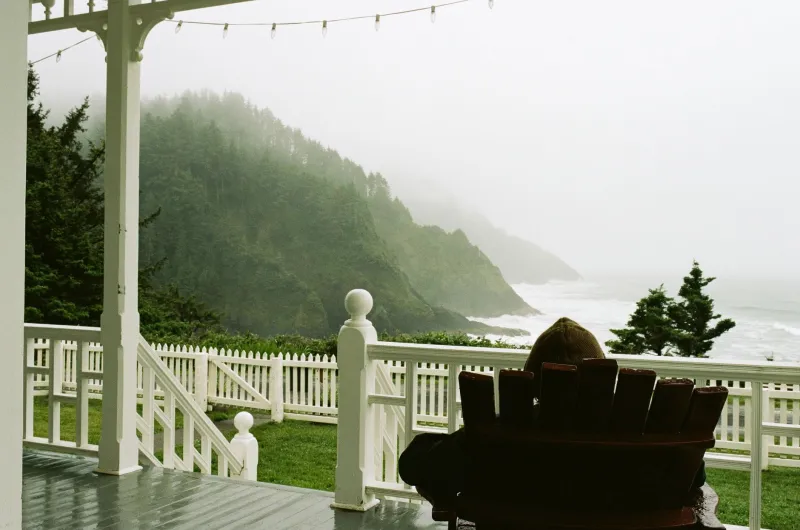
Megan Troutner moved to a narrow valley in western North Carolina with two storage units' worth of furniture, a five-year career plan, and what she describes as "a very aggressive skincare routine." Three years later, one of those storage units is empty, the career plan is a running joke she tells at potlucks, and the skincare routine has been reduced to sunscreen and optimism.
"I didn't decide to want less," she says, sitting on a porch that overlooks a creek she can hear but barely see through the tree cover. "It just kind of happened. Like the valley made certain things feel embarrassing to still care about."
She's not alone in noticing this. Across the country, in places where mountains press in close and the nearest highway feels like a rumor, people are describing a similar internal recalibration. The stuff they chased before — promotions, square footage, the right neighborhood zip code — starts to feel like it belonged to a different person. What replaces it is harder to name, but easier to feel.
Researchers have started paying attention.
The Enclosure Effect
Dr. Priya Menon, an environmental psychologist at the University of Colorado who studies how landscape geometry shapes cognition, uses the term "enclosure effect" to describe what happens when humans spend extended time in topographically bounded spaces.
"There's a reason we've built walled gardens, courtyards, and cloisters for thousands of years," she explains. "Enclosed spaces trigger a particular neurological state — lower cortisol, reduced scanning behavior, a shift from future-projection to present-moment processing. Valleys do this on a massive, immersive scale."
In her research, participants who spent two or more weeks in valley environments showed measurable decreases in what psychologists call "status anxiety" — the ambient, often unconscious comparison of oneself to others. They also reported reduced desire for novelty consumption: the urge to buy new things, try new restaurants, upgrade devices.
"The landscape itself becomes the novelty," Menon says. "When the light hits the ridge differently every single morning, you stop needing your phone to deliver something new."
Does the Valley Attract, or Does It Transform?
This is where it gets genuinely complicated. Talk to enough valley residents and a chicken-and-egg problem emerges: did the landscape change them, or did they already carry the seeds of simpler desires before they arrived?
Jamison Okafor, who runs a small boat repair operation out of a valley community in the Ozarks, has lived there his whole life. He's watched two distinct waves of newcomers arrive — retirees in the 1990s, and remote workers in the last five years — and he thinks both groups were pre-sorted by something.
"The ones who stay, they came here already a little bit tired of the other thing," he says. "The ones who leave after six months, they were testing an idea. The ones who stay were answering a call they'd been ignoring for a while."
Menon doesn't entirely disagree, but she argues the landscape does real work on top of whatever predisposition someone arrives with. "Self-selection explains maybe sixty percent of it. The other forty percent is the place actively doing something to you. That's not nothing."
What Actually Changes
Ask valley residents what specifically shifted in their desires and the answers cluster around a few consistent themes.
Relationships deepen and narrow. Nearly everyone interviewed described a reduction in the number of people they feel close to, accompanied by an increase in the intensity of those relationships. "I have fewer friends here than I did in Atlanta," says Troutner. "But I actually know them. Like, know them know them. That trade feels wildly in my favor."
Ambition doesn't disappear — it relocates. This one surprises people. Valley residents aren't less driven; they're driven toward different targets. The startup founder becomes obsessed with perfecting a sourdough starter. The former marketing executive channels competitive energy into understanding the watershed behind her house. "I'm more ambitious than I've ever been," says Derek Hollis, a former Chicago finance analyst now living in a remote Idaho valley. "I just can't remember what I was ambitious for before."
Material possessions get ruthlessly audited. When you can't get something delivered in two days, and the nearest big-box store is an hour's drive, the question "do I actually need this?" becomes a practical one before it ever becomes a philosophical one. But residents say the philosophy follows. "I started asking myself why I wanted things," says Okafor's neighbor, a retired schoolteacher named Ruth Ann Briggs. "And I couldn't always come up with a good answer."
Time changes shape. This one comes up in nearly every conversation. Not the quantity of time, but its texture. Days feel longer in a way that people describe as a gift rather than a burden. The absence of event-density — the back-to-back scheduling that defines urban and suburban life — creates a kind of spaciousness that residents say they now guard fiercely.
The Friction That Stays
None of this is to suggest valley life is some kind of desire-cleanse that leaves everyone serene and untroubled. The same enclosure that strips away certain anxieties can amplify others. Isolation can curdle into loneliness. The intimacy of small communities, where everyone knows your business, is a pressure not everyone can sustain. And the practical friction of remote living — the long drives, the internet outages, the medical appointments that require half a day — creates its own particular stress.
"People romanticize what gets left behind," says Menon. "They don't always account for what gets added."
Troutner is clear-eyed about this. "There are things I miss. Real things, not just comfort things. I miss the energy of a city at night. I miss having ten coffee shops within walking distance. I'm not pretending none of that is real."
But she stays. And she says that staying, itself, has become a kind of desire she didn't used to have — the want to be somewhere, specifically, rather than somewhere adjacent to everywhere.
What the Valley Asks of You
Maybe the most honest way to frame the valley effect isn't as a subtraction — things you stop wanting — but as a clarification. The noise drops, and underneath it, something quieter and more insistent becomes audible.
For some people, what they hear is a confirmation: yes, this is what I was actually after. For others, it's more unsettling — a recognition that the life they'd been building was constructed around wants they'd absorbed from somewhere else entirely.
Either way, the valley doesn't care. It just sits there, ridge to ridge, doing what enclosed landscapes have always done to the humans inside them.
Changing the question.