When the Clock Disappears: What Valleys Do to Your Sense of Time
Somewhere around day three in a narrow hollow in the Ozarks, a traveler named Dani Okafor stopped checking her phone. Not because she'd lost service — she had a bar or two — but because the number on the screen had started to feel like a lie. "It said 2:47 in the afternoon," she told us, "but the light looked like early morning, and I'd already eaten what felt like two full days of meals. I just stopped trusting it."
That kind of temporal slippage is more common than you might think. Ask anyone who's spent serious time in a deep valley — not a scenic overlook, not a day hike, but actual days living down in the bowl of the earth — and you'll hear some version of the same story. Time doesn't work the same way in there.
The Horizon Is Doing More Work Than You Know
Here's something most of us never think about: we use the sky to tell time. Not just consciously, with sun angles and shadows, but at a deep neurological level. The human brain tracks daylight gradients — the slow brightening of morning, the long fade of evening — as a primary input for its circadian system. That system isn't just about sleep. It governs mood, hunger, alertness, and yes, the subjective feeling of how fast or slow time is moving.
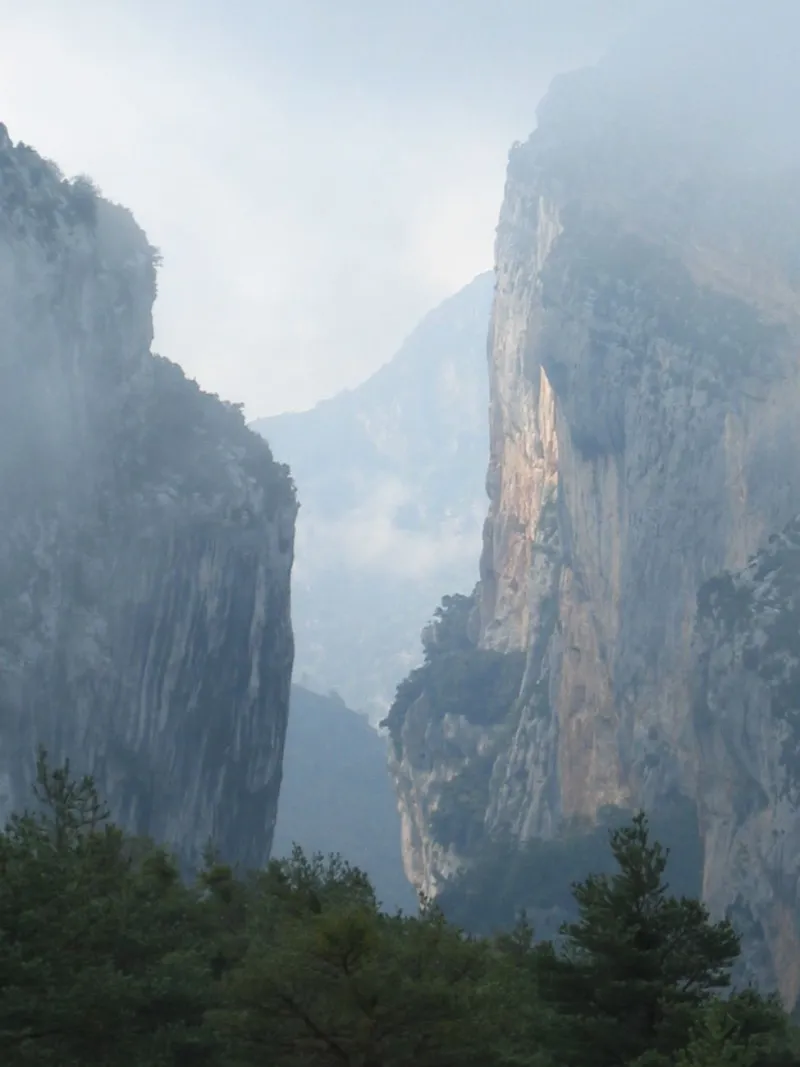
In a valley, especially a narrow one with steep walls, that gradient gets compressed. The sun doesn't arc lazily across an open sky. It punches over the ridgeline mid-morning and disappears behind the opposite wall by mid-afternoon. What you get is a shorter, sharper day — even in summer. The brain, deprived of its usual slow-burn cues, starts improvising.
Dr. Lena Marchetti, a circadian neuroscientist at the University of Colorado, has studied how terrain affects biological clocks in outdoor populations. "The absence of a true horizon is genuinely disorienting to the brain's timekeeping systems," she explains. "We tend to think of circadian rhythm as something purely internal, but it's constantly being calibrated by environmental input. Change the input dramatically — shorten the visible light window, alter the angle and quality of sunlight — and the internal clock drifts. Sometimes it slows. Sometimes it fragments."
Fragments. That word stuck with us.
Geology Speaks in a Different Tense
There's another layer to this, and it's harder to quantify. When you're standing in a valley carved by glaciers or cut by a river over ten thousand years, the landscape itself is communicating on a timescale that makes a human lifespan look like a rounding error. The exposed rock faces, the layered sediment, the ancient bend of a creek — they're all evidence of processes so slow they barely register as movement.
Long-term residents of places like the Hocking Hills in Ohio or the deep hollows of western North Carolina talk about this with a kind of reverence. "You stop thinking in days," says Garrett Foss, who has lived year-round in a narrow valley outside Sylva, NC for eleven years. "You start thinking in seasons. And then eventually, you start thinking in something longer than that. The valley kind of teaches you that."
Foss isn't being poetic — or at least, not only poetic. What he's describing aligns with something psychologists call temporal depth, the ability to perceive and feel connected to timescales beyond one's immediate experience. Open landscapes — plains, coastlines, wide river deltas — tend to emphasize the present moment and the near horizon. Enclosed valleys, with their compressed sky and layered geological storytelling, seem to do the opposite. They pull your sense of time in two directions at once: slowing the present while stretching the past.
The Travelers Who Come for the Disorientation
A growing cohort of adventure travelers is deliberately seeking this out. Not to find themselves — that's a different trip — but specifically to disrupt their relationship with time, which many describe as one of the most relentless stressors of modern American life. The always-on calendar. The notification stack. The feeling that every hour needs to be accounted for and optimized.
Valley travel offers something genuinely rare: an environment that makes those rhythms feel not just irrelevant, but structurally impossible to maintain. The signal drops. The light doesn't cooperate with your schedule. The terrain demands a pace that no productivity app was designed to accommodate.
"I came to the Linville Gorge for a long weekend and left feeling like I'd been gone for two weeks — in the best possible way," says Marcus Delray, a project manager from Atlanta who has made deep-valley trips an annual reset ritual. "My body had completely let go of whatever stressed-out clock I walked in with. I had to rebuild it from scratch on the drive home, and for a while, that rebuilt version was a lot healthier."
That rebuilding process is worth paying attention to. Researchers studying psychological recovery from chronic stress have found that environments which disrupt habitual time perception can accelerate the reset — provided the disruption is voluntary and the setting is safe. A valley, for most travelers, checks both boxes.
How to Go In Intentionally
If you want to actually experience this — not just read about it — a few things are worth knowing before you descend.
Give it at least three days. The first day, your brain is still running on city time. Day two, it starts to negotiate. Day three is usually when something genuinely shifts. Weekend trips often end just as the disorientation is getting interesting.
Leave the schedule at the trailhead. This sounds obvious, but most travelers carry their calendars into the backcountry in the form of meal plans, mileage goals, and departure times. Loosen those. The valley's light cycle will give you all the structure you actually need.
Pay attention to the rock. Spend twenty minutes looking closely at an exposed cliff face — the layers, the colors, the cracks. Let yourself actually reckon with what you're seeing. That practice, repeated, is what seems to trigger the deeper temporal shift that long-term residents describe.
Don't rush the return. Coming out of a valley after several days can feel genuinely jarring. Give yourself transition time. Sit at the ridgeline for a while before you drive back to wherever the clocks are king.
The Valley Keeps Its Own Time
There's a reason so many people who visit deep valleys end up describing the experience in terms of time rather than scenery. The views are real, but they're not the point. The point — or at least, one of them — is that these places operate on a fundamentally different temporal logic than the one most of us live inside every day.
The valley doesn't care what your calendar says. It doesn't know about your deadlines or your quarterly reviews or the thing you're supposed to do next Tuesday. It's been here for thousands of years and it will be here for thousands more, carving itself a little deeper every spring flood, laying down another thin layer of sediment every quiet season.
You get to borrow that rhythm for a few days, if you're willing to go in deep enough and stay long enough to let it actually work on you.
Most people aren't. But the ones who are tend to come back changed — not dramatically, not permanently, but in the quiet, durable way that matters most. They've been reminded that time is not actually the fixed, relentless thing their phones insist it is.
Sometimes it pools. Sometimes it stretches. Sometimes, in a narrow valley with steep walls and a sky the width of a river, it nearly stops altogether.
And for a little while, that is exactly enough.